Quick answer
Use a spreadsheet when custom fields, transparent formulas, easy exports, and long-term control matter most. Choose a banknote collection app when fast capture, built-in photos, mobile lookup, and catalog matching save enough time. A hybrid workflow can combine both if you can export your records and images.
Choose the tool by the record you need to keep
A spreadsheet is a practical default when you want direct control over fields, formulas, exports, and backups. A banknote collection app is usually faster when you want to photograph a note, match it with catalog data, browse the collection on a phone, or check a want list while buying. Neither tool is automatically better for every collector.
The deciding question is not how many features the tool advertises. Ask what you would need if the service disappeared tomorrow. The record should still tell you what the note is, which physical item it describes, where it is stored, how it was acquired, what evidence supports the attribution, and how to retrieve the original photographs.
For a small or unusual collection, a spreadsheet may remain the cleanest system for years. For hundreds of notes with repeated photo and catalog work, a dedicated app can save time. A hybrid setup can use an app for capture and a spreadsheet or open export as the master inventory.
Compare an app and spreadsheet on practical work
Ignore the feature count and compare the tasks you perform every month. A tool that is excellent at adding a common cataloged note may be awkward for local scrip, specimens, checks, error notes, or undocumented varieties. A flexible spreadsheet can accept any item, but every photo link and controlled term depends on your own discipline.
Use this table as a test plan. Replace any assumption with a real sample of five ordinary notes and two difficult ones before moving the full collection.
| Task | Spreadsheet | Collection app |
|---|---|---|
| Add a known note | Manual entry or copied template | Often faster when a catalog match pre-fills fields |
| Handle an unlisted variety | Create any field or description needed | Depends on manual-entry and custom-field support |
| Use photos | Store file links and manage folders separately | Usually easier to capture and browse in one record |
| Check at a show | Good when synced to a mobile sheet | Good when search and offline access are reliable |
| Change the data model | Add, split, or rename columns directly | Limited to the fields and updates the developer provides |
| Audit formulas and totals | Visible formulas and filters | Depends on how the app explains calculations |
| Move to another system | Usually straightforward with CSV or XLSX | Safe only if complete records and original images can be exported |
| Back up independently | Easy to copy the workbook and image folders | Requires an export that can be restored outside the account |
Build a minimum banknote record before choosing software
A collection system is only useful when the same facts are recorded consistently. The Bibliothèque nationale de France recommends putting each kind of information in a separate field because structured data are easier to sort, check, and move into another database. The American Numismatic Association likewise provides a collection inventory spreadsheet as a practical starting point.
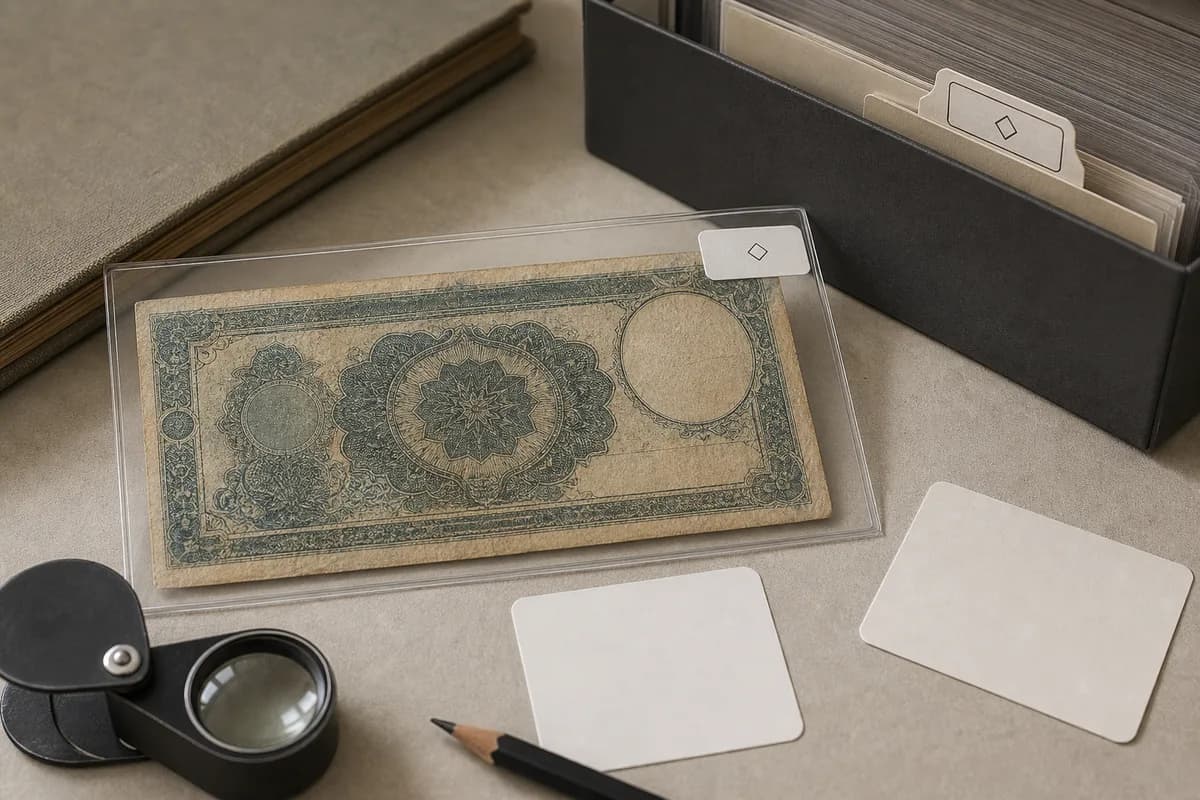
Give every physical note a unique, meaningless inventory ID such as BN-000184. Do not encode the country, year, or value into the ID because those details may be corrected later. Put the ID on the external sleeve label or container, never on the banknote. The Canadian Conservation Institute notes that simple unique numbers tend to remain sustainable and keep objects connected to their records.
Separate observed facts from research conclusions. Country, issuer text, denomination, serial, dimensions, and visible damage can be recorded directly. A catalog number, grade, rarity claim, or value needs a source, date, and level of confidence.
- Identity: unique inventory ID, issuer or country, currency, denomination, series, date, signatures, printer, and catalog reference when verified.
- Physical item: complete serial, prefix and suffix, dimensions, material, watermark notes, visible condition, repairs, and certification details.
- Acquisition: source, date, purchase price, buyer's fee, tax, shipping, provenance, and supporting receipt or correspondence.
- Location: box, album, page, sleeve, or safe reference that can find the exact item without searching the collection.
- Media: front, back, diagnostic details, original filename, photographer, capture date, and any rights or source note.
- Research: attribution source, access date, completed-sale references, estimate date, estimate range, and unresolved questions.
Use a spreadsheet when control matters more than capture speed
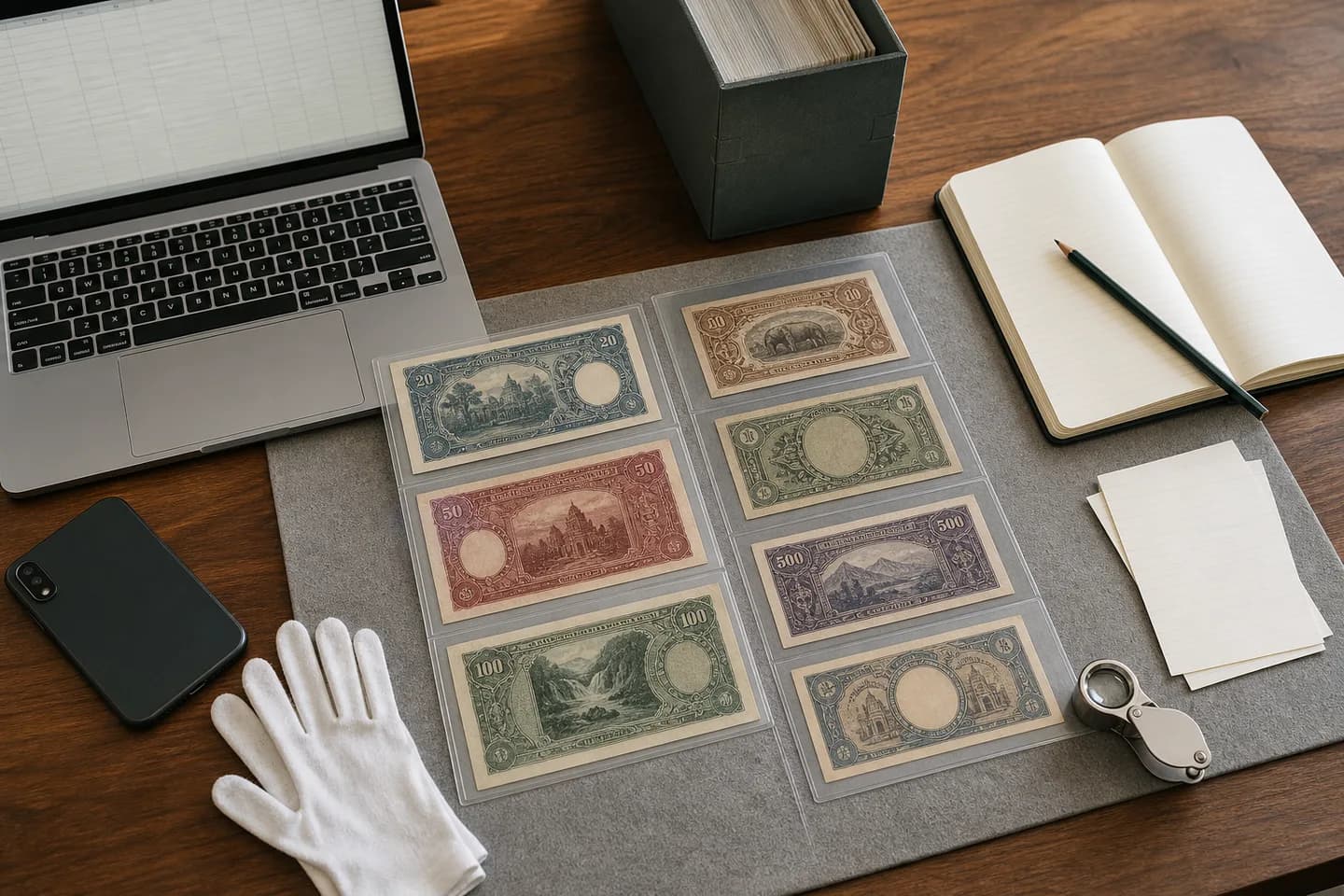
A spreadsheet works well when your collection is small, specialized, or full of items that do not fit a standard catalog. You can create fields for local catalog systems, signature combinations, replacement prefixes, plate positions, provenance, or research notes without waiting for a software update. Filters and pivot tables can answer simple questions without hiding the logic.
It is also easy to preserve. CSV and XLSX files can be copied, opened by several programs, and inspected without a collection-service account. A synchronized sheet can still be checked on a phone at a show, which is one reason collectors in current discussions continue to use Excel or Google Sheets even after testing catalog platforms.
The weakness is labor. A spreadsheet does not identify the note, enforce good photographs, or prevent inconsistent vocabulary unless you add validation rules. Long text, several images, and repeated acquisition records can make one row unwieldy. Keep permanent fields narrow, use separate tabs for transactions or research when needed, and link to an orderly photo folder rather than embedding large images in the workbook.
Use an app when repeated capture and lookup are the bottleneck
A dedicated banknote collection app earns its place when it removes repeated work without taking away your records. Useful features include front-and-back capture, fast catalog search, manual entries for unlisted notes, saved collection views, favorites or want lists, storage fields, and reliable search on a phone. The gain should be measured in completed, accurate records rather than an attractive dashboard.
Test difficult items before subscribing. Add a common modern note, an obsolete world note, a specimen or replacement, a damaged example, and an item outside the main catalog. Check whether you can correct the match, keep your own photographs, enter a full serial, distinguish two copies of the same catalog type, and record where each physical note is stored.
Money AI can help photograph and identify a note, save scan history and favorites, and support follow-up research. It is an assistive identifier, not official authentication, grading, appraisal, counterfeit detection, or a guarantee of value. Its saved results can support an inventory workflow, but collectors who need a durable master catalog should still maintain an exportable record of essential facts.
Keep collection value separate from identification facts
A collection total looks precise because software can add numbers instantly. The underlying estimates may not be comparable. One record may use a dealer asking price, another a completed auction with a buyer's premium, and another an old catalog value for a different grade. Adding them creates a total, not an appraisal.
Keep stable acquisition facts apart from changing market research. Never overwrite the purchase price with today's estimate. Store the estimate as a dated entry with its currency, source, grade assumption, comparable sales, and whether fees are included. This makes the number auditable and prevents a stale estimate from becoming a permanent fact.
Follow the old banknote value research workflow when a note needs an updated estimate. Identify the exact variety, describe condition conservatively, and compare completed sales of genuinely similar examples. If the evidence is thin, record a range or an unresolved status. A tool that cannot show the source and date behind a value should not be your value ledger.
Treat photographs as collection records, not decoration
Photographs let you confirm which physical copy a row describes, check a serial without handling the note, and document condition at a point in time. Start with the complete front and back in even light. Add close-ups only for features that matter, such as a serial, watermark area, signature, overprint, repair, or suspected error.
Use the photo identification guide for a repeatable capture sequence. Keep the untouched originals, then create smaller copies for daily browsing. The Smithsonian keeps preservation masters separate from access derivatives for the same reason: a convenient viewing file should not replace the best source image.
Name files with the inventory ID rather than a changing description. A pattern such as BN-000184-front, BN-000184-back, and BN-000184-serial keeps the images associated with the record. Do not place fragile, weak, or valuable paper in an automatic-feed scanner. The U.S. National Archives warns that these scanners can jam and tear paper.
Run an export, privacy, and backup test before committing
An export button is not enough. Create seven test records, including two copies of the same type, an unlisted note, several photos, a long note, a purchase entry, and a storage location. Export them and inspect the result in a spreadsheet. Confirm that Unicode characters, dates, serial leading zeros, line breaks, custom fields, image links, and relationships survive.
Check whether original-resolution images can be downloaded in bulk and whether the filenames still connect them to the correct records. Read the current privacy and account-deletion terms. Decide whether cloud storage is acceptable for serials, purchase records, addresses in receipts, or information about where a valuable collection is kept. Avoid putting precise home security details into any shared or cloud catalog.
Backups need independence from the live service. The U.S. National Archives recommends three copies on two kinds of media, with one copy off-site. Apply that principle to the workbook, exports, photographs, receipts, and research notes. Open a sample during each review. A backup that cannot be read or reconnected to the right banknotes is not a usable recovery copy.
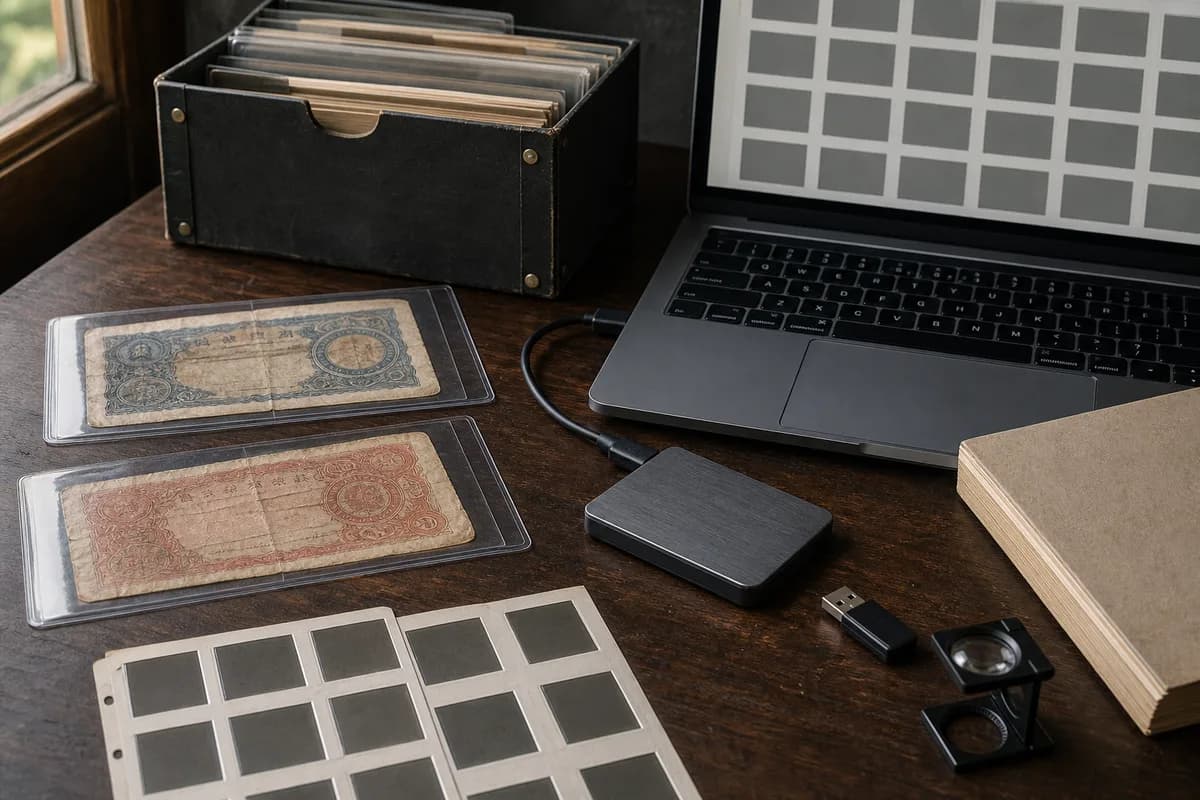
Migrate in small batches and reconcile every record
Do not begin by importing the entire collection. Freeze the old master, create a backup, and move a sample that includes the hardest records. Map each old field to one new field. Preserve the old inventory ID, because changing identifiers breaks the link among sleeves, boxes, photographs, receipts, and research notes.
After the sample works, migrate one storage box, album, country, or series at a time. Compare counts, spot-check serials and locations, and record exceptions. The Canadian Conservation Institute advises proofreading after data entry or migration because transcription errors can separate an object from its information. A count that matches is useful, but a serial and photo check catches wrong-record swaps.
A hybrid system needs the same discipline. Decide which tool is authoritative for each field. For example, the spreadsheet may own identity, acquisition, location, and dated value research, while the app owns capture and saved identification results. Export on a schedule and note the last reconciliation date. If both systems can edit every field, conflicts will eventually appear.
- Back up the old system and keep it read-only during migration.
- Move seven varied records and audit every field and image.
- Preserve the existing inventory ID and original filenames.
- Migrate one physical group at a time and reconcile its item count.
- Spot-check serials, storage locations, costs, and image relationships.
- Record omissions and corrections instead of silently guessing.
- Retain the old export until the new system has survived a full backup review.
Make the decision with a seven-question audit
Start with the paper money collecting guide if the inventory does not yet have a clear purpose. A list built for avoiding duplicates can be simple. Insurance documentation, estate planning, active trading, research, or a large world collection may require stronger acquisition, provenance, location, and photo records.
Whichever tool you choose, protect the physical notes separately. Follow the safe paper money storage guide, keep labels outside the sleeve, and update the location field whenever a note moves. Software cannot compensate for a missing item whose record still points to the wrong box.
- Can I record every item type I actually collect, including unlisted varieties?
- Can I distinguish two physical copies of the same catalog entry?
- Can I search the collection quickly on the device I use while buying?
- Can I download complete records and original photographs in a common format?
- Can I see the source and date behind every condition or value conclusion?
- Can I restore the inventory if the device, account, or service fails?
- Will I still maintain this system after the novelty of setting it up has passed?
Frequently asked questions
Is a spreadsheet enough for a banknote collection?
Yes. A well-structured spreadsheet can record identification, serial numbers, condition, acquisition, storage, photos, and dated value research. It is especially useful when you want custom fields and an exportable master record. It becomes less convenient when photo handling, mobile capture, or repeated data entry takes too much time.
What should a banknote collection app record?
At minimum, it should preserve a unique inventory ID, issuer or country, denomination, series or date, catalog reference when verified, serial number, condition notes, acquisition source and cost, storage location, photo links, and notes. Value estimates should include a date and source instead of replacing permanent facts.
Can a banknote app calculate my collection's value?
An app can total the estimates stored in its records, but that total is not an appraisal. Accurate research still depends on the exact variety, condition, recent comparable sales, fees, and market. Keep the estimate date and evidence visible so an old number is not mistaken for current value.
Should I use both an app and a spreadsheet?
A hybrid setup can work well. Use the app for photographs, identification assistance, and quick mobile reference, while a spreadsheet holds the exportable master inventory. Give each note the same unique ID in both systems and schedule a regular export so the records do not drift apart.
How do I move a banknote collection out of an app?
Test the exit before committing. Export a small sample to CSV or another open format, confirm that every important field survives, download the original images, check filenames and relationships, then import the sample into a spreadsheet. Do not delete the old account until the full export has been backed up and audited.
How often should I back up a banknote inventory?
Back up after substantial additions and on a fixed schedule. Keep the live record, a second copy on different media, and an off-site copy. Open a sample of the files during each review so the backup is proven readable rather than merely present.
Sources and further reading
Explore the primary references used to prepare this collector guide.
- Bibliothèque nationale de France: How to catalogue, digitise, and move a collection of coins
- American Numismatic Association: Collection inventory spreadsheet
- Canadian Conservation Institute: Dissociation and collection records
- Smithsonian Institution Archives: Digitizing Collections
- U.S. National Archives: Digitizing Family Papers and Photographs
- Numista: How do you catalog your banknotes?
- Reddit r/papermoney: How do you catalog a paper-money collection once a spreadsheet gets tedious?